
Tana Baru: The Bo-Kaap’s Sacred “New Ground”
17 November 2026
Climb to the top of the Bo-Kaap, past the last of the brightly painted houses, and the streets give way to an open, grassy hillside on the lower slopes of Signal Hill. Scattered across it are weathered headstones, simple stone markers and a few small, carefully kept shrines. This is the Tana Baru, a name taken from the Malay words tanah baru, meaning “new ground”. It is regarded as the oldest Muslim cemetery in South Africa, and it remains the most hallowed burial ground of Cape Town’s Muslim community.
Many visitors walk past without realising what lies behind the low walls. Yet the story of this hillside, from a hard-won grant of land in 1805 to a mass act of defiance in 1886, is one of the most important chapters in the history of the Bo-Kaap.
A burial ground born of religious freedom
Muslims had lived at the Cape since the early years of Dutch rule. Many arrived as enslaved people from the Indonesian archipelago, India, Sri Lanka and beyond; others were political exiles and scholars banished by the Dutch East India Company for resisting colonial power in the East. For well over a century they could not practise their faith openly, so prayers, lessons and funerals were held quietly, in homes and on the edges of the town.
That changed when the Cape came under the Batavian Republic. Religious freedom was proclaimed on 25 July 1804, and the following year the Muslim community was granted land for its own cemetery. According to South African History Online, the grant was made on 2 October 1805 to Frans van Bengalen, a member of the community. Some historians believe the authorities were keen to keep the loyalty of Cape Muslims at a time when a British invasion seemed likely, and the British did indeed take the Cape at the Battle of Blaauwberg only months later, in January 1806.
The grant may simply have formalised something that already existed. A headstone dated to the 1780s, and early descriptions of burials on the hillside, suggest that people were laid to rest here well before 1805. Over the following decades the cemetery grew into three adjoining burial grounds: the original grant, a second piece of land granted in 1842, and private plots bought by prominent imams for their congregations. Together they cover about a hectare above the streets of the Bo-Kaap, with the entrance off Dawes Street.
Tuan Guru and the kramats
The Tana Baru is best known as the resting place of some of the most respected figures in South African Muslim history. Their graves are marked by kramats, shrines that are visited and cared for as places of prayer and reflection, and they form part of the circle of kramats that pilgrims visit around the Cape Peninsula.
The most celebrated is the kramat of Tuan Guru, whose name means “Mister Teacher”. Born Imam Abdullah ibn Qadi Abdus Salaam, he was a prince from the island of Tidore in present-day Indonesia who was banished to the Cape and imprisoned on Robben Island in 1780. During his years in prison he wrote out copies of the Qur’an from memory, as well as a work on Islamic belief and practice, Ma’rifah al-Islam wa al-Iman. After his release he opened the first madrasah at the Cape in 1793 and became the first imam of the Auwal Mosque on Dorp Street, the oldest mosque in South Africa. He died in 1807 and was buried in the Tana Baru, where his mausoleum stands near the gateway. His sons are believed to lie beside him.
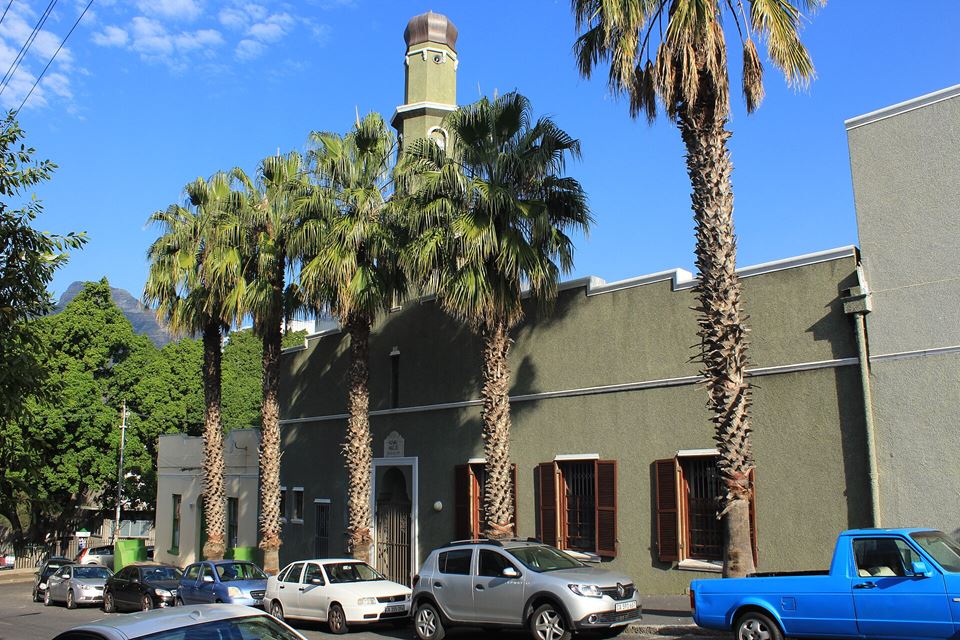
Close by is the whitewashed shrine of Tuan Sayed Alawie, a scholar from Mocha in Yemen who arrived at the Cape in 1744 and spent eleven years as a prisoner on Robben Island. After his release he served the community as its first official imam. Further along lies Tuan Nuruman, affectionately known as Paay Schaapie, who was banished from Batavia in 1770 and died in 1810. True to his simple way of life, he asked that his grave have no surrounding walls, and he is remembered for digging a well nearby so that animals could drink.
Not every notable grave belongs to the earliest years. Midway up the slope lies Abubakr Effendi (1835–1880), a scholar sent to the Cape from the Ottoman Empire. His Bayan al-Din, a religious text written in Afrikaans using Arabic script, is one of the best-known works of what is called Arabic-Afrikaans, a reminder that the Cape Muslim community helped to shape the Afrikaans language itself.
The uprising of 1886
By the 1880s Cape Town was growing fast, and the colonial government was increasingly worried about public health. After a deadly smallpox epidemic earlier in the decade, the Public Health Act of 1883 gave the authorities the power to close burial grounds inside the town. In January 1886 the Tana Baru, along with other inner-city cemeteries, was officially closed.
For the Muslim community the closure was far more than an inconvenience. Islamic practice calls for the dead to be buried quickly and close at hand, and the alternative burial grounds lay far from the homes of the Bo-Kaap. Led by Abdol Burns, community leaders argued that their burials posed no threat to anyone’s health and refused to accept the closure.
Two days after the cemetery was closed, a child in the community died. Rather than take the body elsewhere, about 3,000 people accompanied it to the Tana Baru and buried the child there, in open defiance of the order. Police were called, clashes followed, and Burns and a number of others were arrested. Unrest continued in the town for several days. The Tana Baru Uprising, as it became known, is remembered as one of the earliest acts of mass civil disobedience in Cape Town’s history.
The closure stood, but the cemetery was never abandoned. A handful of later headstones show that occasional burials continued into the early twentieth century, and families kept visiting the graves of their ancestors, as many still do today.
Protecting the new ground
Over the years the hillside suffered. Headstones were broken, buried under rubble or carried away by souvenir hunters, and older photographs show far more markers than survive today. In 1978 concerned members of the community formed the Committee for the Preservation of the Tana Baru, and in 1985 the historian Achmat Davids published The History of the Tana Baru, still the standard work on the cemetery. The Tana Baru Trust, registered in 1998, continues the work of preserving and restoring the site.
Today the greatest pressure comes from the value of the land itself. The Bo-Kaap’s views over the city and harbour have made it one of Cape Town’s most sought-after areas, and residents have long been concerned about development creeping up the hill. The City of Cape Town’s decision in 2019 to place the Bo-Kaap in a Heritage Protection Overlay Zone was welcomed by many as an important step towards protecting the character of the area.
Visiting the Tana Baru respectfully
The Tana Baru is a sacred site, not a museum, and visitors are welcome as long as they treat it with respect:
- Dress modestly. Cover your shoulders and knees; women may wish to bring a scarf to cover their hair, especially near the kramats.
- Mind where you walk. Never step or sit on graves, and keep your voice low.
- Ask before photographing people. Many visitors come to pray at the kramats, and their privacy should be respected.
- Come prepared. The hillside is steep and has little shade, so wear good walking shoes and a hat, and bring water.
A visit to the Tana Baru fits naturally into a walk through the Bo-Kaap. Start at the Auwal Mosque, where Tuan Guru taught, continue to the Bo-Kaap Museum on Wale Street, then climb towards the cemetery and, if you have the energy, on to Signal Hill for the views. Afterwards, treat yourself to a plate of Cape Malay food or find a halal meal in our Halal Guide, and read about the neighbourhood’s famous painted streets in The Colourful Houses of Bo-Kaap.
Standing among the old stones, with the city spread out below and the call to prayer drifting up from the mosques, it is easy to understand why the Tana Baru is so loved. It is the place where Cape Town’s Muslim community first won the right to bury its dead with dignity, and where it stood its ground when that right was threatened. More than two centuries on, the new ground is still holy ground.
Filed under History
More stories

The Colourful Houses of Bo-Kaap: The Story Behind Cape Town’s Brightest Streets
Lime green, hot pink, turquoise and canary yellow: the houses of the Bo-Kaap are among the most photographed in Cape Town. Here…
Read More »
District Six: Exploring the Rich History of Cape Town’s Iconic Neighbourhood
District Six Introduction Brief history of District Six District Six, a historic neighbourhood located on the outskirts of Cape…
Read More »
Discovering the Vibrant Heart of Cape Town City Centre and Bo-Kaap
Introduction Brief history of Bokaap Bokaap, a historic neighbourhood in Cape Town, South Africa, traces its roots back to the…
Read More »